
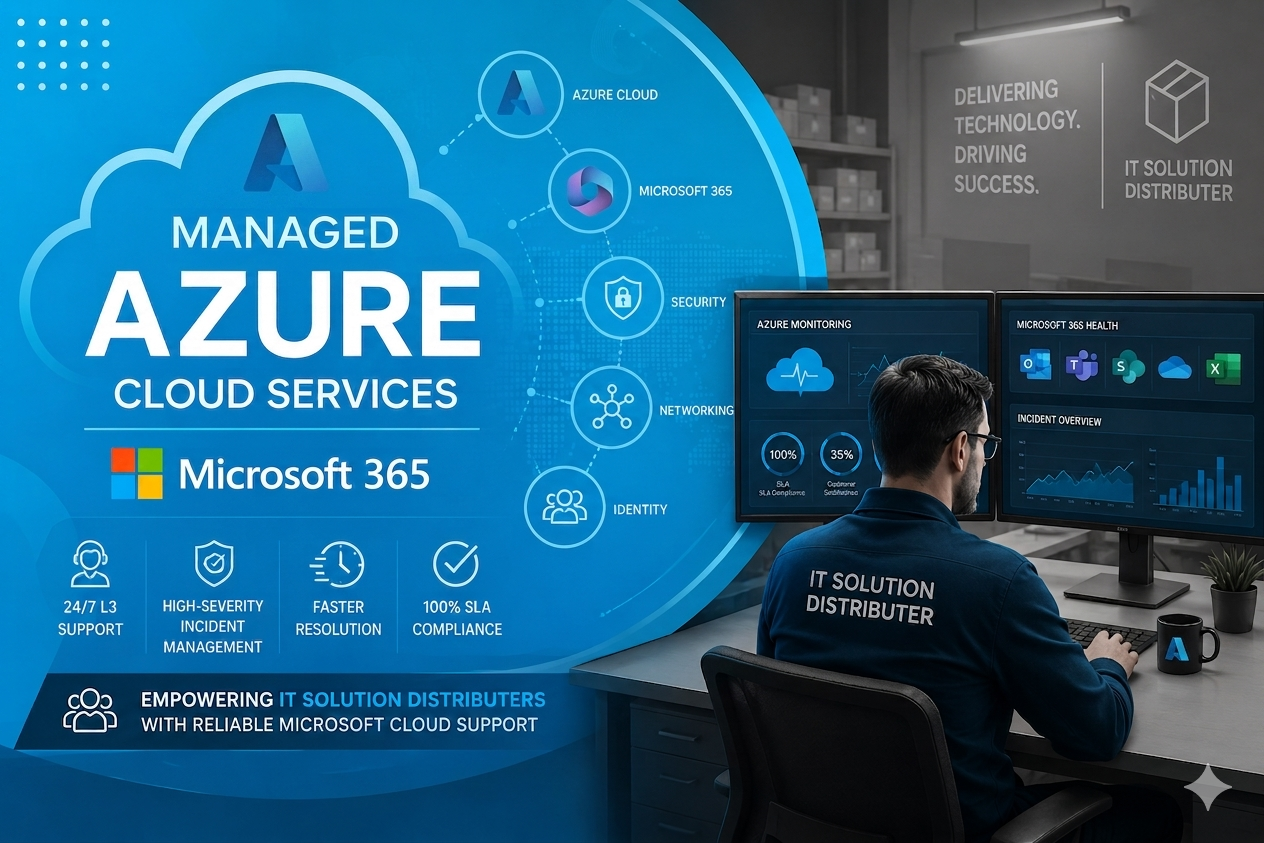
Reducing Cloud Incident Resolution Time Through Azure Managed Services

Overview

When enterprise customers use premium cloud services like Microsoft cloud technologies, support delays can seriously impact their bottom line. In our recent engagement, we worked with a global IT solutions provider managing complex Microsoft cloud environments. Their teams were facing challenges in faster issue resolution across Azure, Microsoft 365, networking, identity, and data platforms while maintaining high customer expectations.

Their internal support teams needed stronger L3 expertise for rapid resolution within SLA and to maintain high customer experience standards.

Client Background

Our client, a US-based technology solutions provider supports enterprises, channel partners, and service providers with technology distribution, managed IT services, and cloud solutions. Operating across 100+ countries, their ecosystem supports large-scale Microsoft cloud, Azure, M365, identity services, networking, and enterprise technology operations.

Challenges

  • Growing Cloud Incidents: Rising P1 and P2 escalations across Azure and Microsoft 365 increased operational load on enterprise support teams.
  • Resolution Delays: Dependence on external Microsoft escalation channels slowed recovery during critical production outages.
  • Limited Cloud Expertise: Supporting Azure, networking, identity, and data environments needed broader multi-domain technical expertise.
  • Complex Incident Management: Cross-technology dependencies made troubleshooting and resolution coordination more difficult during high-priority incidents.
  • SLA Performance Pressure: Maintaining consistent SLA compliance became challenging across large Microsoft cloud environments.
  • Limited Visibility: Slow decision-making due to limited information of cloud technologies.

Our Solutions

  • Centralized M365 Support: We managed Azure VMs, VMSS, networking, SharePoint, Teams, Exchange, Intune, and OneDrive incidents through one dedicated escalation team.
  • Integrated Cloud Security: Entra ID, Conditional Access, Sentinel, Defender, Azure Firewall, ExpressRoute, VPN Gateway, WAF, and Purview issues were resolved collaboratively.
  • Cross-Platform Troubleshooting: Databricks, Synapse, ADF, AKS, APIM, Power BI, Cosmos DB, Containers, and Front Door incidents were handled end-to-end.
  • SLA-Driven 24/7 Support: P1 and P2 incidents followed structured workflows with rapid diagnosis, proactive communication, root cause analysis, and cross-domain expert collaboration.

Technology Stack

  • App Gateway, APIM, AKS
  • Databricks, ADF, Synapse, Azure Data Lake, Microsoft Fabric, Power BI
  • Azure SQL, MySQL, Postgres SQL, SQL VM and Cosmos DB
  • Azure VMs, Azure Stack HC
  • Microsoft 365
  • Sentinel, Defender

Business Value Propositions

  • Faster Incident Resolution: Reduced high-severity incident resolution timelines by over 35% across Microsoft cloud environments.
  • Stronger SLA Performance: Maintained near-perfect SLA adherence for critical Azure and Microsoft 365 support escalations.
  • Improved Operational Efficiency: Reduced downtime, improved responsiveness, and improved overall customer satisfaction levels.

Future Opportunities

By centralizing Azure and Microsoft 365 escalations under one experienced support team, the client improved operational response, reduced dependency on external escalations, and improved overall service consistency across critical environments. The next phase includes Microsoft Copilot readiness, automation-led operations, and more proactive cloud management across enterprise environments.


Protecting Financial Infrastructure Through Zero Trust Using Microsoft Azure

Overview 

A leading finance organization in Australia needed to migrate its core systems from an aging data center to Microsoft Azure. Daily financial operations were supported by a crucial 500GB SQL database that could not afford extended outages. Thus, existing configurations had issues with expansion, security, and performance. 

Krish designed a modern cloud setup using Azure and implemented Zero Trust security that improved its security, ensured business continuity, and established a foundation for future workload expansion. 

Client Background

A well-known Australian financial services organization that delivers financial products and services to customers across the regionrelies heavily on tech to support daily operations. The organization manages large volumes of sensitive financial data and operates under strict regulatory and compliance standards. 

Challenges

  • Legacy Infrastructure Limiting Growth: The client was running critical finance applications on an ageing on-premises datacenter. They lacked scalability, causing performance issues and slowing support.
  • High Security and Compliance Pressure: They struggled to meet security requirements, audit, and regulatory standards because of on-prem systems. 
  • Lack of a Standard Cloud Foundation: There was no structured cloud landing zone to support governance, networking, and scalability for future workloads.  
  • Lack of Centralized Application Access Security: Exposing applications to users and partners required strong protection against threats.  

Solutions

  • CAF-Aligned Azure Landing Zone: Built a secure Azure foundation using a hub-and-spoke design for strong governance and clear network separation. 
  • Protected External Access with WAF: Used Azure Application Gateway to protect applications, block common web threats, and protect customer-facing systems. 
  • Reliable Migration of SQL Database: Migrated the 500GB SQL database using tested methods with reduced downtime. 
  • Centralized Network Security and Threat Protection: Implemented multi-layer Zero Trust and Azure Firewall for attack defense.

Technology in Use

SQL Server 
Azure Firewall 
Defender for Cloud 
Azure Monitor 

Business Values

  • Reliable Data Migration: Successfully migrated to a 500GB SQL database with optimized performance. 
  • Measurable Performance Gains: Improved application response times by 45%. 
  • Stronger Security Posture: Reduced risk through a Zero Trust security model. 

Future Scope

This Azure Zero Trust model protects critical financial apps while ensuring easy monitoring, smooth performance across hybrid environments, and better cloud-to-on-prem connectivity. The new setup also opens the door for the adoption of cloud-native apps, better analytics, and more secure infrastructure. 

Escaping Google Workspace: A Singapore University’s High-Wire Migration to Microsoft 365

Overview

A leading Singapore-based university partnered with Krish to migrate from Google Workspace to Microsoft 365. Despite a complex environment and user base, the entire transition was completed within just 12 weeks, modernizing collaboration, compliance, and digital governance.

Client Background

A top-tier Singapore university with over 40,000 students and faculty, known for academic excellence, research leadership, and cross-disciplinary innovation. It operates on a global scale and invests heavily in cutting-edge digital infrastructure to support education and collaboration.

Problems 

  • Fragmented Collaboration Tools: Departments used inconsistent communication tools, leading to confusion and inefficiencies.
  • Compliance and Data Sovereignty: Google Workspace didn’t meet local regulatory requirements for data hosting and governance.
  • User Experience Gaps: Faculty and students faced usability and interoperability challenges between Google apps and other platforms.
  • Lack of Identity and Access Control: Managing user access and provisioning across tools lacked uniformity and security.

Solutions 

  • Enterprise Migration to Microsoft 365: Executed a full-scale migration of emails, calendars, and files across departments with minimal disruption.
  • Change Management & Training: Designed and delivered training programs to onboard staff and students onto Microsoft 365 effectively.
  • Unified Collaboration Platform: Introduced Microsoft Teams and SharePoint Online to unify communication and content management across academic units.
  • Centralized Identity Governance: Implemented Azure AD for streamlined authentication, access provisioning, and policy enforcement.

Business Value 

  • Flawless Migration: Achieved 100% data migration success with no loss.
  • Strengthened Security: Improved security posture via advanced Microsoft tools.
  • High User Adoption: Saw 85% of users smoothly transition within two weeks.
  • Increased Productivity: Enhanced collaboration through integrated M365 tools.
  • Cost Savings: Reduced IT overhead and consolidated software costs.

The migration to Microsoft 365 was successfully completed in 12 weeks, providing the University with a more secure, scalable, and collaborative environment. The project highlights the importance of detailed assessment, phased migration, and user training for success.

Thank you for contacting us. Our team will contact you shortly.